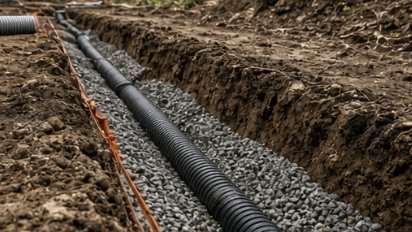
Campton is five villages spread over fifty-two square miles — Campton Hollow, Lower Village, Upper Village, West Campton and Beebe River — with the Pemigewasset running down the middle and the Mad and the Beebe coming in off the mountains to meet it. Roughly a third of the housing here was built for somebody’s vacation, and not one lot in town is on municipal sewer. We do the earthwork that comes with that: clearing inside a river corridor wider than the neighbors’, foundations on ground the geologists named after this town, camp roads off the notch, and drainage in a valley that floods.
The thing that catches people in Campton is the river overlay. Ten of the fourteen towns along the Pemigewasset have some form of shoreland district; Campton’s reaches at least 500 feet out from the river’s edge where Woodstock and Bridgewater stop at 250, and inside it the excavation of sand, gravel or other earth material is a prohibited use outright. Along the river the dimensions stack up on top of that: 200 feet of frontage per dwelling unit off the ordinary high water mark, 50 feet of building setback, 125 feet before a septic system. The lot-size arithmetic has teeth too — the minimum runs off a table keyed to soil and slope, wetland cannot be used to fulfill any of it, and neither can ground over 35 percent, which in a town topping out at Mount Weetamoo’s 2,548 feet takes a real bite out of some parcels. There is no municipal wastewater plant anywhere in Campton, so every one of those lots is a septic lot; the Campton Village Precinct runs a groundwater well system for the precinct, and the Waterville Estates Village District, chartered under RSA 53 across parts of Campton and Thornton, runs water and its own secondary roads for the hillside.
Before you fall in love with a Campton lot, measure 500 feet back from the river and work out how much of what’s left is wetland or steeper than 35 percent. That is the number that decides what you can build, and it is routinely smaller than the deed acreage suggests.
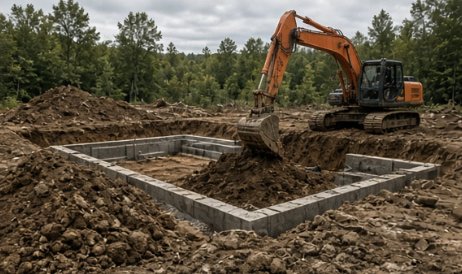
Foundations, pads, trenches, and grading — test pits first, flat quotes, on schedule.
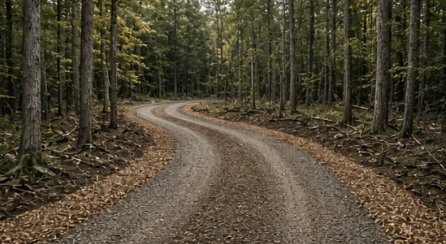
Gravel driveways built with real base and crown — and washouts fixed for good.
Free site walks, test pits before quotes, flat pricing, and a crew that knows Lakes Region ground.
Tell us where the property is and what you’re trying to do. We’ll walk the site, talk it through, and give you a straight, flat quote.
We reply to every request within 2 business hours.